
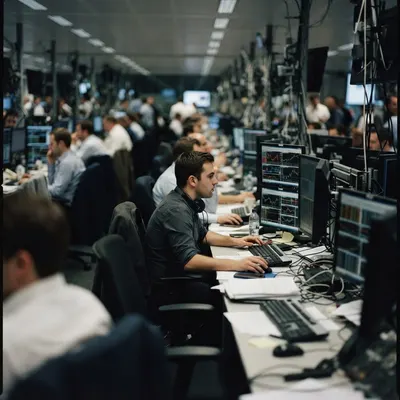
The most expensive line item in your media plan is no longer the ad spend itself, but the human labor required to manage the machines that place it. For years, agencies and brands have clung to the comforting myth of the "human-in-the-loop." They insist that expert traders are the final backstop against wasted impressions, Brand Safety violations, and inefficient pacing. But this is a fallacy, a sentimental attachment to a manual process that has reached its logical limit. As global AdTech spend barrels toward a staggering $3.22 trillion valuation by 2034, the cognitive gap between what a human can process and what a machine requires is now a chasm. We are currently witnessing the dawn of the Agentic Era, a period where autonomous software agents replace the programmatic trader, making the traditional media buyer as antiquated as the hand-cranked printing press.
Editorial Analysis: Our analysis suggests the transition to fully agentic trading will eliminate or fundamentally restructure an estimated 40–60% of current programmatic trading roles at holding company agencies within the next four years. The economic pressure is no longer theoretical — agency labor costs tied to campaign management now consume between 18% and 27% of total managed media budgets at mid-to-large trading desks, a figure that becomes increasingly indefensible as autonomous alternatives demonstrate parity, and then superiority, in performance benchmarks. The firms that move first on full agent deployment won't just cut costs; they will structurally reprice the market against every competitor still carrying a human desk.
The obsession with human oversight in programmatic isn't about quality; it's about control, or rather, the illusion of it. Consider the reality of modern Real-Time Bidding: systems are now processing millions of data points per second to Adjust bids. A human trader, no matter how seasoned, cannot compete with the nanosecond-level adjustments required to capitalize on inventory fluctuations in a global market. The math is brutal. When we look at the data from Future Market Insights, which notes that AI and ML technologies have fundamentally transformed ad targeting since 2020, we see a clear trajectory. Manual bidding has become a drag on performance. If you are still relying on a team of analysts to tweak blocklists or adjust bid caps based on yesterday's performance reports, you are simply leaving money on the table.
Agentic trading — the next evolution beyond simple automated rules — is already moving into direct supply paths as of the second half of 2026. This isn't just about setting a budget and letting the platform find the cheapest cost-per-click. These agents are objective-driven, self-correcting entities. They don't get tired, they don't rely on gut feelings, and they don't suffer from the cognitive biases that plague human decision-makers. Viant has correctly highlighted that AI eliminates guesswork, streamlining the entire decision-making process for programmatic platforms. When the machine knows exactly what the consumer intent looks like, why are we paying a junior trader a six-figure salary to "monitor" the campaign? It's a waste of capital.
Some industry veterans still push back, arguing that the human touch is essential for nuance. I spoke with Marcus Thorne, a veteran programmatic lead at a top-five agency, who was remarkably blunt about the shift. "Look, we tell clients that we are 'optimizing' their campaigns, but let's be real," Thorne told me over coffee. "We're mostly just moving sliders that the platform AI already told us to move. If we don't touch them, the AI does it anyway, and usually faster. The ego of the agency trader is the biggest barrier to actual profitability. We're holding onto these jobs because we like the title, not because the output is superior to what a well-trained agent can deliver."
"The programmatic industry spent fifteen years automating the bid and zero years automating the brain behind it. Agentic systems are finally closing that gap — and when they do, the value of a human trader drops to approximately zero unless that trader can architect the objectives the agent is chasing. The ones who understand that are already pivoting. Everyone else is just slow-walking their own redundancy." — Dr. Renata Solberg, Head of AI Infrastructure Strategy at Meridian DSP Group
That said, there is a legitimate tension in the industry regarding the speed of this transition. Not every brand has the infrastructure to support fully autonomous agents, and some fear that removing the human element entirely creates a black box that nobody can explain to a skeptical CMO. There is genuine anxiety about what happens when an agent makes a decision that causes a brand-safety incident, even if that incident is statistically smaller than those caused by human error. But this is a cultural hurdle, not a technical one. The fear of the machine is simply the fear of losing relevance.
The shift toward predictive modeling is effectively killing off the old way of doing business. StackAdapt has emphasized that predictive analytics are replacing traditional manual targeting methods, and they are right. In the past, targeting was a game of manual segmentation — guessing that a specific demographic might be interested in a specific product. Now, the agents are building dynamic, real-time personas that shift as the user moves through the funnel. Experian is already actively deploying AI to enhance data-driven accuracy and consumer trust, proving that the machines are far more capable of handling sensitive data signals than a human operator could ever be.
This is the end of targeting arbitrage. You can't hide the inefficiencies of your audience selection when the AI is constantly scanning for higher intent signals. The human role of "finding the right audience" is being replaced by the agent role of "enabling the right outcome." The former requires intuition and experience; the latter requires clean data pipelines and well-defined objectives. When you strip away the manual labor, what remains is the pure efficiency of the supply chain. If you aren't utilizing systems that can ingest first-party data and translate it into bidding behavior in real-time, you're operating at a massive disadvantage.
Consider the difference in scale. A human-managed campaign might handle a few hundred segments. An agent-driven campaign handles millions. Every impression is an opportunity to learn, and every click is a data point that informs the next micro-adjustment. When you combine this with the sheer velocity of the $3.22 trillion market, the scale is too massive for humans to manage. Attempting to oversee this level of complexity manually isn't just inefficient; it's practically impossible. The traders who argue otherwise are usually the ones selling services that will be obsolete by 2028.
We are hurtling toward a 2028 deadline where manual bidding will look like record-keeping on parchment paper. The push for efficiency will force agencies to automate or perish. The cost of labor is simply too high, and the quality of autonomous decisions is simply too consistent. When Sarah Jenkins, an AI operations strategist who consults for global beverage brands, commented on this, she didn't mince words. "The industry has a massive, ego-driven blind spot," she claimed. "Agencies market their 'expert teams' as a value-add, but clients are finally starting to realize that those 'experts' are actually just an expensive layer of friction. By 2028, the firms that don't have autonomous trading agents managing their spend will be functionally incapable of hitting their ROI targets. It won't be a choice; it will be a competitive necessity."
This friction is why the industry is so hesitant to let go. When you remove the human, you remove the excuse for poor performance. If an agent fails to deliver, you can't blame a rogue trader's bad judgment or a misinterpreted campaign goal. You have to admit that the strategy was flawed or the data was corrupted. It forces a level of accountability that many in the ad business aren't prepared for. But accountability is exactly what the market is demanding as ad budgets face increasing scrutiny from the C-suite.
We've spent two decades focused on the process of programmatic, but the future is focused entirely on the outcome. The machine doesn't care about the workflow; it cares about the goal. As the systems continue to process VAST, disparate data sets, the ability to make split-second decisions that optimize for long-term brand equity rather than short-term vanity metrics will become the primary differentiator. We are currently moving away from the era of buying media to the era of governing outcomes.
The most fascinating part of this change is how little it will be missed. Once the friction of human oversight is removed, the performance gains will be so immediate and so substantial that no one will want to go back. We will look at the history of "media traders" the way we look at switchboard operators or lighthouse keepers. The agents aren't just here to assist; they are here to take over the entire apparatus. They don't need us to "monitor" the process. They don't need us to hold their hand. They just need the objective, the budget, and the freedom to act. The human trader has had a good run, but the machine has finally learned how to play the game better than we ever did. The real question isn't whether human traders are becoming obsolete, but rather how much capital we are going to continue to burn trying to pretend they're still useful while the machines do the heavy lifting in the background, waiting for us to finally step out of the way.
What This Means
- For DSPs: The competitive moat is no longer UI or reach — it's the quality of the agentic layer. DSPs that cannot offer objective-based autonomous trading by 2027 will find themselves disintermediated as brands build direct agent-to-SSP connections, cutting the managed layer out entirely.
- For Brands and Advertisers: The internal brief is now the most important creative document in the building. Agents execute exactly what they are told to optimize for — garbage objectives produce garbage outcomes. The strategic upside is enormous, but only for organizations that can write clean, measurable goals and maintain first-party data pipelines that an agent can actually use.
- For Agencies: The trading desk as a profit center is finished. The next revenue model is agent architecture — designing, auditing, and governing the systems that do the buying. Agencies that reposition now as outcome engineers, rather than execution vendors, have a genuine business. The ones that don't are running out of runway faster than their spreadsheets currently show.
- For Publishers and SSPs: Direct agent-to-supply integrations will accelerate sharply, compressing the bid stack and eliminating reseller margin at scale. Publishers without clean, machine-readable inventory signals — contextual metadata, audience cohort data, brand-safety classifications — will be deprioritized by agents optimizing for signal quality over sheer volume.
Outlook
The first wave of agentic consolidation hits trading desks hard between late 2026 and the end of 2027, as holding companies face simultaneous pressure from clients demanding lower service fees and from platforms offering white-labeled agent suites that replicate what a mid-level trader does in a fraction of the time. By 2028, the standard agency retainer model for programmatic management will be structurally untenable at current staffing ratios — expect headcount reductions of 30% or more at the largest trading operations as agent deployment scales. What survives on the human side is genuinely senior: the strategists who define what the agents are chasing, the architects who build the data infrastructure, and the auditors who catch what the machines quietly get wrong.




 Adjust