
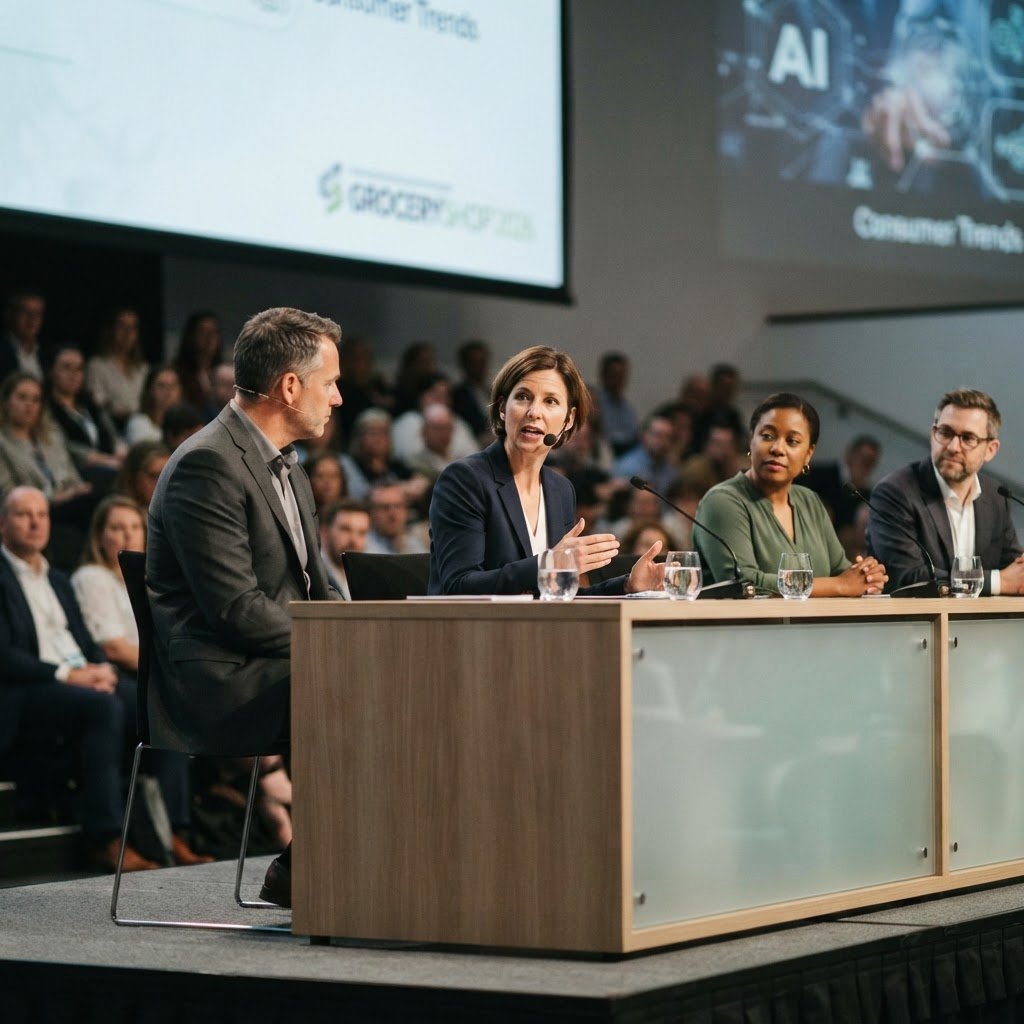
The grocery industry is being fundamentally reshaped by three invisible forces: artificial intelligence, retail media, and the rapid adoption of GLP-1 medications. As these pillars collide, the industry is bracing for a seismic shift in consumer behavior that will dictate the next decade of bottom-line performance. Groceryshop 2026, set for September 22-24 at Mandalay Bay in Las Vegas, is positioning itself as the epicenter for decoding this new reality. With 4,000 retail professionals expected to descend on the desert, a third of them C-suite heavyweights, the signal-to-noise ratio is shifting toward high-stakes, operational pragmatism.
Our analysis suggests that GLP-1 adoption is not a peripheral trend retailers can afford to monitor from a distance, it is a structural demand shock already compressing average basket sizes by an estimated 12–18% among active users. As this cohort scales toward a projected 30 million U.S. prescriptions annually by 2026, the retailers who fail to reconfigure their ad-spend architecture around high-margin, lower-volume purchasing patterns will face measurable margin erosion within two to three fiscal quarters.
The event's programming isn't just about glossy presentations; it's about the grit of implementation. The organizers have confirmed that Chris Rogers, CEO of Instacart, will take the stage to address It's the main storefront.
"The real challenge isn't just the tech, it's how we reconfigure the entire supply chain and ad-spend model when the average consumer basket is fundamentally altered by GLP-1 demand shifts," said Rocquan Lucas, Head of Strategy at Groceryshop. "We're moving past the hype phase of AI and into the uncomfortable phase of integration, where legacy systems struggle to keep pace with real-time intent data."
The immediate fallout of this focus is clear: vendors who cannot prove direct, measurable Attribution for retail media spend are going to be gutted. The event's 'Meetup' program, which is slated to facilitate over 30,000 co-matched business meetings, is a blunt-force attempt to force that accountability. It's an aggressive speed-dating model for the enterprise, stripping away the pleasantries of the trade show floor in favor of high-velocity deal-making. If you aren't ready to show the math behind your ad-tech stack, you're just wasting time in the desert.
"Retail media networks are sitting on first-party data that most DSPs would trade their entire programmatic stack to access, but the conversion infrastructure connecting that data to actual closed-loop attribution is still embarrassingly primitive at most major grocers. Until retailers stop treating their ad networks as auxiliary revenue lines and start treating them as core operating infrastructure, we're going to keep having the same conversation at every conference." said Dana Merritt, VP of Retail Media Strategy at Clearpath Commerce Group
Retailers are currently sitting on a gold mine of first-party data, yet they are paralyzed by the need to balance profit margins with the shrinking volume of goods sold to GLP-1 users. When the calorie count per cart drops, the ad-tech strategy has to shift from volume-driven replenishment to high-margin, discovery-based advertising. It's a transition that requires a level of AI-driven precision that many incumbents still lack.
While the industry loves to talk about personalization, the uncomfortable truth is that the infrastructure often fails at the point of purchase. We're promising smooth hyper-targeting while the physical shelf remains a logistical mess, often disconnected from the digital ad campaign currently running on the consumer's phone. Groceryshop is effectively betting that the path forward lies in these granular, operator-led conversations rather than broad industry platitudes.
The pressure is mounting. Executives are no longer looking for broad trends; they are looking for the exact mechanism that converts a curious shopper into a repeat buyer who is, perhaps, eating less but spending differently. As the adtech industry prepares for the September summit, the question remains: are we actually solving for the consumer's changing biological reality, or are we just rearranging the deck chairs on a digital shelf that is becoming increasingly expensive to maintain?
- For DSPs and SSPs: Grocery retail media is rapidly becoming a closed-loop, walled-garden environment. Platforms without direct integration agreements at the network level will lose access to the highest-intent purchase signals in Programmatic Advertising. The window to negotiate those deals is narrowing fast.
- For CPG Brands and Advertisers: A shrinking average basket does not mean a shrinking budget opportunity, it means the budget has to work harder. Brands targeting GLP-1-adjacent categories (high-protein, functional foods, portion-controlled SKUs) have a narrow first-mover window before competitive spend floods those placements.
- For Publishers: Retail media budgets are being reallocated away from broad reach and toward closed-loop, retailer-owned environments. Publishers without a credible commerce content or shoppable media offering will see CPG ad dollars continue to migrate toward Kroger Precision Marketing, Instacart Ads, and their direct competitors.
Groceryshop 2026 will almost certainly produce a wave of pilot announcements, AI-driven personalization partnerships, clean room data-sharing agreements, and retail media measurement frameworks that sound impressive in a press release. The harder truth is that most of those pilots will stall inside legacy ERP systems that were never designed to ingest real-time behavioral signals. Expect the real consolidation to happen in the twelve months following the conference, as undercapitalized retail media networks either accept acquisition offers or quietly sunset. The grocers who move fastest on closed-loop attribution, not just the technology, but the organizational restructuring behind it, will own the category's most valuable ad inventory by 2027.


 Kroger Precision Marketing