
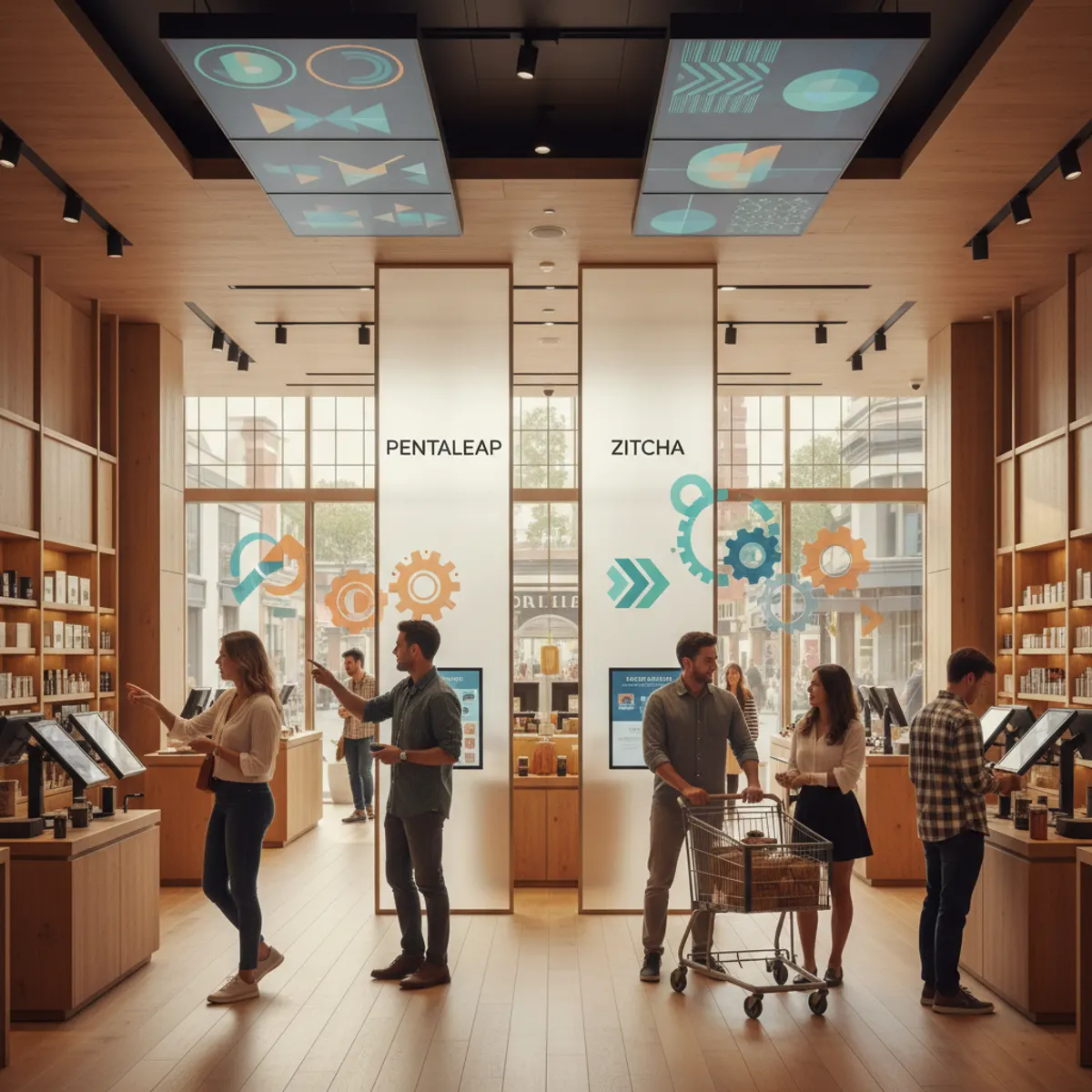
Pentaleap and Zitcha have announced a partnership designed to fix one of retail media's most persistent structural problems: the gap between the teams who sell advertising to brands and the teams who manage those brands' commercial relationships with the retailer.
It sounds like an internal org chart issue. It's not. It's costing retailers real money.
Our analysis suggests that organizational misalignment between merchant and media teams is suppressing retail media yield by as much as 20–30% at mid-tier retailers - revenue that simply evaporates when brand conversations happen in silos and ad packages are sold without reference to existing trading agreements. The retailers who close this gap first will have a structural pricing advantage over those still running two separate conversations with the same brand partners. AdWire estimates the addressable opportunity in better-coordinated retail media operations exceeds $4 billion globally by 2027, much of it sitting with the mid-market retailers
Most retailers operate with a fundamental tension baked into their business. Merchant teams - the buyers, category managers, and commercial directors - have deep knowledge of brand relationships, trading terms, and what each supplier actually needs from a promotional standpoint. Advertising teams, often sitting in entirely separate divisions, are selling sponsored product placements, display inventory, and offsite media packages to those exact same suppliers. The two groups rarely talk. When they do, the conversation is often awkward, overlapping, or flatly contradictory.
The result is that brands get pitched twice, messaged inconsistently, and frequently end up buying retail media that doesn't align with what they've already agreed to in trade negotiations. That's frustrating for brands. But it's also a quiet revenue leak for retailers - because disjointed experiences erode advertiser trust, and advertiser trust is the foundation of any sustainable retail media network.
"The retailers still treating their merchant and media teams as separate P&Ls are setting themselves up for a brand backlash they won't see coming. I've watched FMCG companies quietly deprioritize spend with three different retail partners in the last eighteen months - not because the audiences weren't right, but because the buying experience was chaotic and the reporting told two different stories. Clean operations aren't a nice-to-have. They're the price of entry for serious brand budgets." - Sarah Okonkwo, VP of Commerce Media Strategy at Meridian Retail Advisors
"Retailers have built powerful advertising businesses, but they haven't always built the internal connective tissue to make those businesses work cohesively," said Tom Burgess, CEO at Pentaleap. "What we're trying to do with Zitcha is give both sides of the house a shared view - so the merchant team and the media team aren't accidentally undermining each other."
Pentaleap brings AI-driven campaign optimization to the partnership, with technology built specifically for retail media environments where product availability, pricing signals, and inventory data need to feed directly into ad decisioning. Zitcha contributes its retail media platform, which is designed to give retailers a white-labeled, end-to-end system for managing and monetize their media networks - with an emphasis on making the experience workable for both brands and the retail operations teams sitting behind them.
The practical output of the partnership is an integrated workflow where Pentaleap's optimization engine connects into Zitcha's platform, giving retailers a single environment to manage campaign performance while maintaining visibility into the commercial relationships that underpin those campaigns. Merchant teams can see what's running. Media teams can see what's been agreed commercially. Nobody is flying blind - or, at least, that's the goal.
"The brands we work with are sophisticated. They know when a retailer's left hand doesn't know what the right hand is doing," said Troy Townsend, CEO at Zitcha.
There's an uncomfortable truth sitting underneath all of this. A significant portion of retail media growth to date has been driven not by genuine advertiser enthusiasm but by commercial pressure - brands buying placements because their trading terms make it awkward not to. That's not a healthy foundation. And as retail media networks multiply and brands face more and more inventory to choose from across more and more retailers, the ones with messy internal processes and low advertiser confidence are going to feel the squeeze first.
The Pentaleap-Zitcha partnership is explicitly betting that operational coherence - the boring stuff, the internal alignment, the shared data layer - is going to matter more than it used to. That's probably right. As brands get more rigorous about measuring return on their retail media spend, they're going to gravitate toward partners who can demonstrate that their ad products are built on a foundation of actual organizational competence, not just reach.
Townsend made a point of emphasizing that the integration was built with mid-market retailers in mind - not just the tier-one grocery giants who can afford to build bespoke internal platforms from scratch. "The retailers who are going to grow their media businesses fastest aren't necessarily the biggest ones. They're the ones who build the right systems early," he said.
Burgess echoed that. His view is that AI-driven optimization only delivers its full value when it's operating on clean, well-structured data from a retailer whose internal teams are actually coordinating. "Garbage in, garbage out - that's still true. But the garbage is increasingly organizational, not just technical," he said.
The partnership is live now, with initial deployments underway across retailers in Zitcha's existing customer base. What it quietly puts on the table is a question that every retail media network is going to have to answer: is your organization actually built to support the media business you're trying to run?
- For brands and advertisers: Expect cleaner buying experiences and fewer instances of being double-pitched by the same retailer's disconnected teams - but hold partners accountable to it. Ask for evidence of internal data integration before committing incremental budget.
- For mid-market retailers: The window to build proper infrastructure before brand scrutiny intensifies is narrowing. Retailers still running merchant and media operations on separate systems - or separate spreadsheets - are accumulating a competitive deficit that will be expensive to close in 18 months' time.
- For retail media technology vendors: The Pentaleap-Zitcha model signals that point solutions are losing ground to integrated stacks. Vendors selling standalone optimization or standalone platform tools without clear interoperability stories are going to face harder conversations with procurement teams.
- For SSPs operating in retail media: Fragmentation risk is real. If retailers consolidate their internal operations around integrated platforms like this one, the number of touchpoints available to third-party supply-side vendors may contract - particularly at mid-market retailers who have less inventory volume to distribute across multiple partners.
The structural problem If Pentaleap and Zitcha can demonstrate measurable yield improvement from their integrated deployments within the next two to three quarters, they'll have a case study that sells itself across Zitcha's customer base and well beyond it. The harder test comes when retailers with more complex commercial architectures - multiple banners, private label complications, tiered trading terms - try to replicate the same coherence at scale. That's where the operational thesis either holds or starts to fray.
-
Retail Media Networks Face Measurement Challenges Amid Growth
-
Retail Media Networks Face Measurement Challenges Amid Growth
-
Retail Media’s 'Closed Loop' Myth Is Stifling Real Innovation


